Podcast episode profile for 19. Battle of the nerds
Nerds and geeks are peaceful right? Nope! We battle as much as anyone else, but seldom in a fisticuffs fight. You know, it's all about words and feeling superior because we have an HP 48 calculator, an Amiga instead of an Atari or because our favorite demo group just won in the great demo party. DJ Daemon dives into why we need to form groups or “cliques” where we feel elevated and enlighted as opposed of those other “troglodytes” of the competition.
ericade.radio knows the chiptune and demoscene! We're the radio station playing all the best tunes from the most prominent, promising or trending artists in the scene. We also know about the artists and songs as well.
This profile was last updated on: 2026-10-26 16:00:07
🎙 Curated by DJ Daemon
View all episodes
🎙 About the podcast
Flashback, tracks from the past
We have covered the demo scene since 2020, and play all the great chip tune music as well. Join us to hear tracked music combined with commentary from the geek-of-all-trades: DJ Daemon. He was once known as Daemon in the Amigaworld, and brings you stories about Amiga, retrocomputing, C64, demos, the demo scene and all things nerdy in the retro world.
We play tracker music composed on Protracker, Screamtracker, Fasttracker and Impulsetracker. It's music composed on Amiga and the retro-PC. Genres such as Chiptune, Synthwave and Retro electro.
Track Details
- MD5
4c467036bc3d92b0ef6e5bb3c297392b- SHA-1
e99f2b2ead34f2ff92102252c833d8dfa2324f73- SHA-256
3e897ca6e985e3dd2a132fa9b5bb433516521fe56ffe037c3e4b73b68bc49e83- SHA-384
3df42334ff5d8c5699136f5cd2b964639321554be62b5f784be4597a1d34b6b436bde8470f067a5ee68f6c91a071d27f
Transcript
Jingle – Top of the hour – Good evening sez Nicole.
You are listening to the Ericade Radio Network. Good evening and welcome to another hour of Amiga Retro Music. Amiga Flashback is here and it's better than all other podcasts. Because I say so. Yeah, you probably remember all the grandstanding about superior computers, demo groups, music and all that jazz. Rivalry by any other name. This is also the theme of today's show.when we talk about them and us. Let me, DJ Daemon, take you to the battlefield of nerds. Once again, into the fray.
DJ Daemon – The Intro where he runs into the fray, again!
Gopher – Enemy Engaged
Swedish enlightened media doctor Anders Hansson once got a radio show here in Sweden. He spoke about mental and physical health and mentioned a scientific experiment. A number of people were shown a see-through glass jar filled with marbles and asked to guess how many they were in there. The answer was not something that the scientists really cared about. The participants were only told if they guessed too low or too high.Almost directly, the people formed two groups. The two high group and the two low group. Those had a friendly, but present feeling of being superior to the other groups. This is a human condition, we always do this. You know, Team Atari vs Team Amiga, Team Fairlight vs Team Triad, Team BBS with menus vs Team Command Driven BBS. We remember those, don't we?
DJ Daemon – Why do we even join groups?
WLsRogrbMxI – Nerdy Girl
The demo scene here in Sweden and elsewhere has always been full of competition. As I previously have spoken about on this podcast, it was sometimes a very hostile environment for everyone. And few classic demo groups from Sweden are more well known than Triad and Fairlight. Fairlight was founded in 1987 by Strider and Black Shadow.The former had right-wing conservative views and that became synonymous with the group itself and was seen in earlier demos. A common slogan was kill a commie for mummy and when might is right. Far from all members were right-wing, so this may have become more of a style than actually trying to sell a political view. Fairlight made demos but are probably more famous as a cracker group.that removed copyright protections and distributed software and games freely. You see, this was not illegal in Sweden for the first years, but it was later criminalized. Fairlight is still active today and Strider has moved to the United States. Triad was the chief competition and was founded in 1986. They started a war of some sort with Fairlight by releasing demos with a lot of communist symbols and messengers.In a way, they became the Nemesis. They were serious about being rivals, but did probably not mean anything with the symbols other than, yeah you know, taking off Fairlight. And yes, they're also still active. But from what I can see, they are most likely on more friendly terms with Fairlight today. As they say, mods turns into rockers in the end.
DJ Daemon – Fairlight vs Triad, not quite a love story, or is it?
Fairlight – Cracktro
Per Almered – TRIAD MUSIC
Atari vs Amiga We've spoken about this a number of times I know But it's the original computer war for me That's strictly said not true As computer wars are as old as the commercialization of computing itself Both those computers were very successful home computers in their own right And they were based on the same Motorola CPUThe Atari had a number of consoles and computers, but the Atari ST-series went toe to toe with the Amiga 500. The Atari has inferior graphics, but a slightly faster CPU due to overclocking by 1 MHz. And it also had a very interesting thing, a set of MIDI connectors. The Amiga had better graphics, a very powerful architecture with co-processors for many tasks.It had multitasking and of course a great sounding 8-bit sampler. The Amiga was snapped up by graphics artists and animators while the musicians chose the Atari. The nerds fought each other over which was the better computer until the home computer era was over and they both had to move to the next great thing. Whatever that might have been.For me it was the PC that I have stuck with since then.
DJ Daemon – Amiga vs Atari! The Amiga wins! Always! I might be biased. See next song.
505 – Lazer – Ataris grave
Windows vs almost anything else. Microsoft early on caught the anger and hatred of the nerds. The company was successful and aggressive. Many stories, true or otherwise, circulated about their exploits. They were rumored to have strong-armed other companies into doing their bidding or outright destroying them. Windows was a success as well.but initially quite a primitive hack of an operating system, even by the standards of the day. The first versions could not freely move Windows around the desktop due to a patent that Apple owned. MS-DOS that Windows ran on was a real mode OS without memory protection or built-in capabilities to address more memory than the real mode allowed it to.About later versions of Windows, there was a saying that Windows is a 32-bit extension and a graphical shell to a 16-bit patch to an 8-bit operating system originally coded for a 4-bit microprocessor which was written by a 2-bit company that can't stand one bit of competition. But in 1995, Windows 95 pretty much killed off a lot of the competitioneven though it had a shaky start and many problems and bugs. In my opinion, the Amiga workbench was superior to the Windows 3.1 by leaps and bounds, but Windows 95 was a more problematic challenger and by then the Amiga was fading into obscurity and the home computers were all but dead. This fight evolved, if I may say so.into the Windows vs Linux, the Windows vs Mac and the Windows vs whatever. When Windows 95 was launched, Microsoft licensed Rolling Stones song Start Me Up. It played in commercials, cleverly omitting the part of the song that went, it makes a grown man cry.
DJ Daemon – Windows 95 and Microsoft vs the world. They win. Fudge!
Cry – WINDOWS !!!!!!!!!!!!
DJ Daemon – Not quite the geek's choice.
Let me guess that is not a popularity contest winner for this guy. Windows with a number of exclamation marks. And Windows was kinda, you know, not the geek's choice and I'm fighting with my Windows 10 workstation here so I know this feeling all too well.
Jogeir Liljedahl – God = Martin Galway
DJ Daemon – The story behind Galway's C64 song.
Galway is God. that's Martin Galway actually. The song done by Jogair Liljedal, I can tell you. The idea is that this song obviously was done by Mr. Galway on a C64. So this is an Amiga remix, so to speak. At least that's what it says in the comments.
Aceman – My first console
DJ Daemon – Remembering the first console. Mine was a C64…
first console. I know mine. It was actually a Commodore 64, this classic thing. Or maybe it was the Amiga that I later got, that was a real console so to speak. Or maybe it was the Texas Instrument, my father's Texas Instrument. Anyway, Cream of the Earth coming up.So what drives nerd rage? I don't know actually. That is quite a little riddle. I consider myself both a geek and a nerd and I'm proud of it so to speak. But I do think we have kinda maybe a little bit of self-esteem issues or something. I don't know about everyone but you know, can I show those?owners of Atari's that hey, we are better users because we have better computers and in the end we did all this, both Atari users and Amiga users against the PC users because you know, they were winning.
Amiga – Cream of the earth
DJ Daemon – What drives nerd rage?
Beek – Substitutionology
DJ Daemon – On pronouncing the song above and then he has a John Lennon “Imagine”-esque hippie meltdown.
This is the Arikade Radio Network, an Amiga flashback. Beak gives us substitutionology. Yeah, I could say it. Fantastic. We're going on with beat, with mind of a dreamer. And geeks and nerds, aren't we kinda dreamers? And aren't we kinda rivals? Because we feel our dreams are the ones that should become true.
BeaT – Mind of a Dreamer
DJ Daemon – bidding you adieueueueeueueeu (How is this spelled?)
So, Amiga Flashback is done for this week. This is DJ Daemon bidding you adieu. It's the best French I can do. And hope that you will be tuning in next Saturday. Or, yeah, listen at the podcast. The station is available at radio.arcade.net.
!Cube – Scotchman in a skirt
DJ Daemon – It's a kilt and Scotch is a 3M brand tape, thank you very much.
Scotch man in a skirt by Cube. Two things. First of all, it's called a kilt and second of all, it's called a scott.
Radix – Superglam
🏷 Storytelling
Episodes built around a specific story or piece of history — from the demoscene, retro computing, or the station itself.
Play History
- 🕘 2026-10-23 02:00:06
- 🕘 2026-10-17 15:00:06
- 🕘 2026-10-13 04:00:06
About the artist Amiga Flashback View all tracks ›
Started in december 2020, Amiga Flashback was the first name of "Flashback, tracks from the past". It features nice midnight DJ banter from DJ Daemon, interviews, discussions about retro-stuff and lots of tracked music. Most of it is Amiga tracked tunes. In May 2021, it was renamed and started allowing all kinds of tracked tunes instead of mostly Amiga ones.
🎧 8,552 plays on ericade.radio
🎙 People in this podcast episode

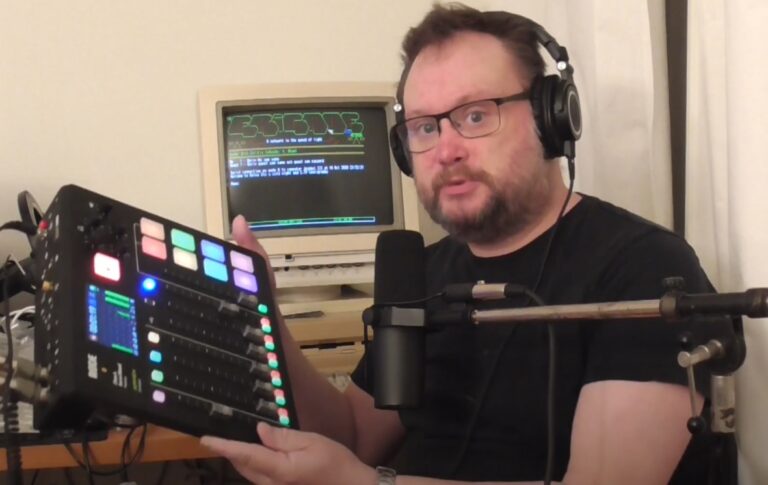
He got his Commodore 64 in 1989 and his first Amiga in 1990. A huge fan of tracker music and have had a long standing dream to create a radio show playing that kind of music. In 2020, that dream came true and in december Amiga Flashback started as a podcast. It was later renamed Flashback, tracks from the past and here we are.
He is also an orga for Swedish demo party Edison and a total retro nerd.
📡 Podcast details
Mp3 file details
 Open the waveform at full size (opens in a new tab)
- Scan status Whether the station’s analyser could read this mp3. “OK” means every number in this box was measured from the actual audio, not copied from a tag that somebody typed.
- OK
- measured from the file itself
- Scanned When the file was last analysed. If the mp3 is replaced afterwards, these numbers describe the old version until it is scanned again.
- File size How much room the mp3 takes on a disk, and how much data you use when you play or download it. It is roughly the bit rate multiplied by the length.
- 82.6 MB
- 86 614 746 bytes
- File last changed When the mp3 on our server was last written - usually the day it was uploaded, or encoded again.
- Length How long the recording plays. It is measured from the audio itself, so it is right even when a tag in the file says something else.
- 59:59
- minutes : seconds
- Bit rate How much data is spent on each second of sound. More data keeps more detail when the audio is squeezed into an mp3: 128 kbit/s is acceptable, 192 is good, and 320 is the most an mp3 can hold.
- 193 kbit/s
- good quality
- Sample rate Digital audio is a long row of measurements of the sound wave. This is how many are taken every second. 44.1 kHz is the CD standard and 48 kHz the video and broadcast standard - both capture everything a human ear can hear.
- 44.1 kHz
- 44 100 measurements a second
- Channels How many separate signals the file holds. Mono is one. Stereo is two - left and right - which is what lets a sound be placed somewhere between your speakers.
- Stereo
- 2 channels
- Codec The method used to shrink the audio. MP3 leaves out the detail an ear is least likely to miss, which makes the file about a tenth of the size of the original recording.
- MP3
- Loudness The average loudness of the whole recording, the way a listener hears it (“integrated loudness”, in LUFS). The closer to 0, the louder. Music services aim for about -14 and podcasts for about -16, so that you do not have to reach for the volume between tracks.
- −11.1 LUFS
- on the loud side
- Loudness range The distance between the quiet passages and the loud ones, in LU (1 LU is 1 dB). A small number means an even, compressed sound - good in a car or on a phone. A large number means big swings between soft and loud.
- 4.5 LU
- very even
- True peak The highest level the signal ever reaches, including the peaks that appear between the measurements when the file is turned back into sound. 0 is the ceiling: above about -1 dBTP, a recording can crackle (“clip”) on some players.
- 0.8 dBTP
- close to the ceiling - may distort on some players
- Dynamic range How far the loudest peaks stand above the loud parts of the recording, in dB - the “DR” number that music collectors compare albums by. A low number (under 8) means the sound has been squeezed until everything is equally loud: punchy, but tiring to listen to. 14 and up means the music has room to breathe, with real hits and real quiet. It says nothing about how loud the file is: turning the volume down does not change it. Chip music made of steady square waves naturally lands low.
- DR 9
- 8.6 dB · moderately dynamic
- Left channel level The average strength of the left channel over the whole recording (“RMS”), counted in dB below the loudest level a digital file can hold (dBFS). More negative means quieter. Compare it with the right channel.
- −13.1 dBFS
- average (RMS) over the whole file
- Right channel level The average strength of the right channel over the whole recording (“RMS”), counted in dB below the loudest level a digital file can hold (dBFS). More negative means quieter. Compare it with the left channel.
- −13.1 dBFS
- average (RMS) over the whole file
- Channel balance The left level minus the right level. Close to 0 dB means both sides are equally loud. More than about 1 dB and the whole mix leans towards one ear.
- 0.07 dB
- balanced
- Stereo width How strong the part that DIFFERS between left and right is, compared with the part they share. A very low number (-40 dB or less) means both sides carry the same sound - mono in practice. A higher number means a wider stereo picture; a very high one can sound thin on a single speaker.
- −9.4 dB
- ordinary stereo
- Cover art in the file Whether a picture is stored inside the mp3 itself. A player shows it as the album art when the file is played somewhere else - in a car, on a phone, offline.
- Yes
ID3 tags Text stored inside the mp3 file itself - title, artist, album and so on. It is what a music player, a phone or a car stereo shows while it plays the file, and it travels with the file wherever it is copied.
Measured from the mp3 file on our server by the station’s own analyser. Point at a label, or select its question mark, for what the number means.
📻 Station details
Amiga demo tunes, chiptunes and dreamy synth pieces from ProTracker, FastTracker 2, Impulse Tracker and the trackers that came after. Streaming around the clock, with live broadcasts from the demoparties. Made by sceners, for the demoscene.
Comments