Song profile for Staring Danger in the Eye
ericade.radio knows the chiptune and demoscene! We're the radio station playing all the best tunes from the most prominent, promising or trending artists in the scene. We also know about the artists and songs as well.
This profile was last updated on: 2026-10-27 02:48:42
🎙 Curated by DJ Daemon
View all songs
Track Details
- MD5
0dd7abebd3a111b789067708bfb7a97f- SHA-1
f1a8d8127ee8d118e0fdabc45a684591fa8d1741- SHA-256
bda5218a2f51cade760218544d10106c721836b546b910574a4f89ba8c1e8691- SHA-384
9540912e1ab577b22f043d4c40da718a16c750126d44b560d27b87faadf5cf70ccda05ede9500cc777e9274f1789ccb0
Play History
- 🕘 2026-10-18 08:37:47
- 🕘 2026-10-11 18:43:30
- 🕘 2026-10-06 05:45:55
About the artist K. Jose View all tracks ›
He describes himself like this on Modarchive: "Hi there, I'm K. Jose, aka KJ (not kill joy).I started tracking music in July 2014, but many of my previous modules prior to 2020 that were not uploaded have been lost.". He is still doing tracker music in 2026.
🎧 1,508 plays on ericade.radio
Additional data from ModArchive
Sample & instrument names
spiccato
Oboe
BD
ambient_roll_1
ConcertHarp-small-2020070
Pizzicato
33188__komponist__vibnot0
BS1
Violin Section _loud
374275__samulis__tubular-
444491__breviceps__short-
375497__samulis__cymbals-
xylophone
Timpani
374413__samulis__viola-se
374404__samulis__viola-se
374408__samulis__viola-se
373647__samulis__oboe-sus
373650__samulis__oboe-sus
373653__samulis__oboe-sus
373648__samulis__oboe-sus
bd

ambient_roll_1
C3_mf3
E3_mf1
G3_mf1
B3_mf1
D4_mf1
F4_mf1
C5_f1
E5_mf1
G5_mf1
B5_mf1
Pizzicato C3
Pizzicato C4
Pizzicato F4

375493__samulis__cymbals-
374704__samulis__xylophon
374700__samulis__xylophon
374705__samulis__xylophon
373933__samulis__timpani-
373934__samulis__timpani-
373935__samulis__timpani-
Comments on ModArchive
Remake of "In the Face of Danger" with orchestral samples. The original FM S3M was an orchestral attempt using FM
synthesis.

Pos 0 main track for quad surround
Pos F stereo track, should be mono friendly

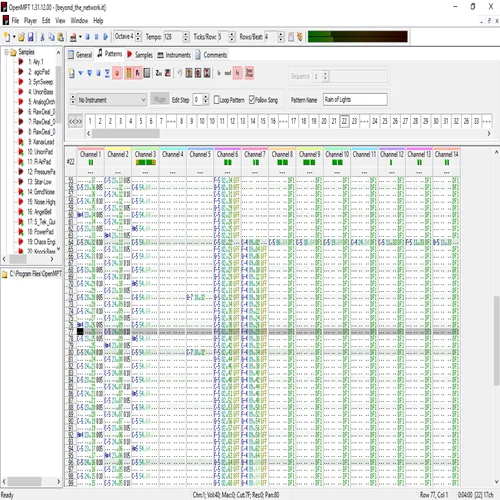
Did this in MPTM instead of IT because of a LOT of large high quality stereo samples and the use of a DirectX reverb
effect. Though it can be done in IT due to MPT hacks, they're really supposed to be used only in MPTMs.
Data from modarchive.org, last checked 2026-10-21 22:05:18.
Mp3 file details
 Open the waveform at full size (opens in a new tab)
- Scan status Whether the station’s analyser could read this mp3. “OK” means every number in this box was measured from the actual audio, not copied from a tag that somebody typed.
- OK
- measured from the file itself
- Scanned When the file was last analysed. If the mp3 is replaced afterwards, these numbers describe the old version until it is scanned again.
- File size How much room the mp3 takes on a disk, and how much data you use when you play or download it. It is roughly the bit rate multiplied by the length.
- 4.9 MB
- 5 124 911 bytes
- File last changed When the mp3 on our server was last written - usually the day it was uploaded, or encoded again.
- Length How long the recording plays. It is measured from the audio itself, so it is right even when a tag in the file says something else.
- 3:33
- minutes : seconds
- Tempo How fast the tune goes, in beats per minute - the speed you would tap your foot at. This was measured automatically by the station's analyser (ffmpeg and bpm-tools' "bpm"), not typed in by a person, so it is not guaranteed to be 100% accurate: tunes without a steady beat can throw it, and where it is wrong it is usually exactly half or double the tempo you would count.
- 180 BPM
- a fast tempo
- Bit rate How much data is spent on each second of sound. More data keeps more detail when the audio is squeezed into an mp3: 128 kbit/s is acceptable, 192 is good, and 320 is the most an mp3 can hold.
- 192 kbit/s
- good quality
- Sample rate Digital audio is a long row of measurements of the sound wave. This is how many are taken every second. 44.1 kHz is the CD standard and 48 kHz the video and broadcast standard - both capture everything a human ear can hear.
- 44.1 kHz
- 44 100 measurements a second
- Channels How many separate signals the file holds. Mono is one. Stereo is two - left and right - which is what lets a sound be placed somewhere between your speakers.
- Stereo
- 2 channels
- Codec The method used to shrink the audio. MP3 leaves out the detail an ear is least likely to miss, which makes the file about a tenth of the size of the original recording.
- MP3
- Loudness The average loudness of the whole recording, the way a listener hears it (“integrated loudness”, in LUFS). The closer to 0, the louder. Music services aim for about -14 and podcasts for about -16, so that you do not have to reach for the volume between tracks.
- −16.2 LUFS
- typical for streaming and podcasts
- Loudness range The distance between the quiet passages and the loud ones, in LU (1 LU is 1 dB). A small number means an even, compressed sound - good in a car or on a phone. A large number means big swings between soft and loud.
- 5.7 LU
- moderate
- True peak The highest level the signal ever reaches, including the peaks that appear between the measurements when the file is turned back into sound. 0 is the ceiling: above about -1 dBTP, a recording can crackle (“clip”) on some players.
- −3.1 dBTP
- safely below the ceiling
- Dynamic range How far the loudest peaks stand above the loud parts of the recording, in dB - the “DR” number that music collectors compare albums by. A low number (under 8) means the sound has been squeezed until everything is equally loud: punchy, but tiring to listen to. 14 and up means the music has room to breathe, with real hits and real quiet. It says nothing about how loud the file is: turning the volume down does not change it. Chip music made of steady square waves naturally lands low.
- DR 10
- 10.1 dB · moderately dynamic
- Left channel level The average strength of the left channel over the whole recording (“RMS”), counted in dB below the loudest level a digital file can hold (dBFS). More negative means quieter. Compare it with the right channel.
- −19.4 dBFS
- average (RMS) over the whole file
- Right channel level The average strength of the right channel over the whole recording (“RMS”), counted in dB below the loudest level a digital file can hold (dBFS). More negative means quieter. Compare it with the left channel.
- −19.5 dBFS
- average (RMS) over the whole file
- Channel balance The left level minus the right level. Close to 0 dB means both sides are equally loud. More than about 1 dB and the whole mix leans towards one ear.
- 0.13 dB
- balanced
- Stereo width How strong the part that DIFFERS between left and right is, compared with the part they share. A very low number (-40 dB or less) means both sides carry the same sound - mono in practice. A higher number means a wider stereo picture; a very high one can sound thin on a single speaker.
- −1.3 dB
- very wide
- Cover art in the file Whether a picture is stored inside the mp3 itself. A player shows it as the album art when the file is played somewhere else - in a car, on a phone, offline.
- No
ID3 tags Text stored inside the mp3 file itself - title, artist, album and so on. It is what a music player, a phone or a car stereo shows while it plays the file, and it travels with the file wherever it is copied.
Measured from the mp3 file on our server by the station’s own analyser. Point at a label, or select its question mark, for what the number means.
📻 Station details
Amiga demo tunes, chiptunes and dreamy synth pieces from ProTracker, FastTracker 2, Impulse Tracker and the trackers that came after. Streaming around the clock, with live broadcasts from the demoparties. Made by sceners, for the demoscene.
Comments